of the dock family
- can grow as much as 2 cms per day
- 3 metres by June
- root as small as 0.8 grams can grow
- can extend several metres around
and beneath
- 3 year treatment plan approx cost for small sq metre area £1500 - £2500
Japanese Knotweed
What is Japanese Knotweed?
What
is Japanese Knotweed? Japanese Knotweed was introduced to the UK as an
ornamental plant during the 1800s. It is commonly found today along
railway lines, riverbanks, roads and footpaths, in graveyards, on
derelict sites or anywhere that it has been dumped, dropped or
deposited.
What does it look like?
Japanese
Knotweed, identified as a Bamboo like plant, grows with enough force
that it can through penetrate concrete other solid foundation structure,
therefore posing a risk to the structural integrity of the buildings
themselves.
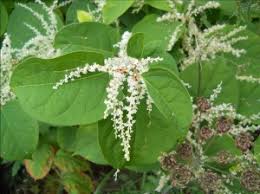
Japanese
Knotweed forms dense clumps up to 3 metres in height. It has large,
oval green leaves and a stem that is hollow and similar to bamboo.
Usually in early spring (although it can be later in the year) the plant
produces fleshy red tinged shoots. These can reach a height of 1.5
metres by May and 3 metres by June.
This
plant can grow as much as 2 cms per day and will grow in any type of
soil, no matter how poor. Towards the end of August clusters of cream
flowers develop and then produce seeds that are sterile. The plant dies
back between September and November.
Beneath
the position of any stand of Japanese Knotweed will exist an extensive
underground root (rhizome) network that can extend several metres around
and beneath depending on ground conditions. Japanese Knotweed does not
produce viable seeds in the UK. The spread of the plant is vegetative,
i.e. all new plants are created by fragments of existing plants. A
fragment of root as small as 0.8 grams can grow to form a new plant. It
is widely assumed that that there is only one species of Japanese
Knotweed. In fact there are three species to be found within the United
Kingdom which are:
- Fallopia Japonica (common Japanese Knotweed)
- Fallopia x Bohemica (hybrid between Fallopia Japonica and Fallopia Sachalinensis)
- Fallopia Sachalinensis (Giant Knotweed)
Why is it a problem?
Japanese
Knotweed grows pretty much anywhere, from field edges to sand dunes,
through tarmac and out of lampposts. The speed with which it has spread
to all parts of the UK has been spectacular when you consider that it
does not leave seeds behind but grows from pieces of the plant or root
system that is cut and transported by people or by water.
Because
Japanese Knotweed does not originate in the UK, it does not compete
fairly with our native species and is able to spread unchecked. Once
established, Japanese Knotweed shades out native plants by producing a
dense canopy of leaves early in the growing season. Although Japanese
Knotweed is not toxic to humans, animals or other plants, it offers a
poor habitat for native insects, birds and mammals.
Japanese
Knotweed is an asexual plant and can only reproduce by its own plant
tissue, be it roots or stem nodes. In late summer flowering takes place
but these flowers are sterile and incapable of producing further plants.
Its roots, known as rhizomes, spread outwards beneath the soil surface.
Growth is rapid, Japanese Knotweed can be as tall as 3 – 4 metres by
the end of the autumn. It is important to remember that a mature
Japanese Knotweed plant has at any given time, a root system that has
spread up to 7 metres in all directions.
Because
Japanese Knotweed can only spread by its own plant tissue, it is mainly
the activities of man which has ensured the spread of this invasive
weed. Removing any plant debris and dumping it elsewhere will ensure
that fresh colonies become established. Strimming of stem growth will
additionally spread plant material which will be prone to
re-establishment. The flow of water in rivers and streams is the only
other way that nature has of spreading plant material. The action of
moving water adjacent to river banks breaks off small parts of Japanese
Knotweed which then spread downstream to make fresh colonies elsewhere.
Knotweed
instinctively searches sources of water damaging further any existing
gaps and cracks in and around the affected areas. Although the scale of
damage may vary from those who are judging damage will generally run in
the form of:
Sewers, Drains and Down pipes
Crack
and gaps within pipes will be further widend and damaged by Knotweed.
The persistent build up of the roots will lead to the slowdown and
eventual blockage of the drain run itself requiring in the worst form
the renewal of the affected drains.
Patios, Paths and Driveways
Surfacing Knotweed will see the bulbs penetrating through paving Patio slabs and joints, tarmac and through brick paving.
Boundary and Retaining walls
Tightly
pack clumps of Knotweed can lead to the undermining of the garden
walls' shallow foundations leading to the eventual destabilisation and
possible collapse of the wall itself.
Outbuildings and Conservatories
Knotweed
can overwhelm destabilization smaller outer buildings that have light,
poorly built or freestanding foundations (sheds). Like garden walls this
can lead to the sudden and part collapse of the structures themselves.
Valuers however will attribute greater importance should a conservatory
be affected due to the close proximity to the main buildings
foundations.
What are the environmental issues associated with Japanese Knotweed?
Under
the Wildlife and Countryside Act 1981 / Wildlife (Northern Ireland)
Order 1985 it is an offence "to plant or otherwise encourage" the growth
of Japanese Knotweed. This could include cutting the plant or roots and
disturbing surrounding soil if not correctly managed.
Any
Japanese Knotweed polluted soil or plant material that you discard,
intend to discard or are required to discard is classed as 'controlled
waste' and should be disposed of in accordance with the Environmental
Protection (Duty of Care) Regulations 1991.
Japanese
Knotweed should be disposed of in a licensed, lined landfill site. Be
sure that you notify your waste haulier that the waste to be removed
contains Japanese Knotweed. You should also contact the landfill site
several days before any material containing Japanese Knotweed is taken
there to allow a suitable area to be prepared for its disposal.
Control of Japanese Knotweed
Although
there are a number of options available for the treatment of Japanese
Knotweed, the majority of these require a number of years in order to be
effective. The two methods outlined below are the most effective in the
time scales generally required by the construction industry.
Japanese Knotweed Risk Category
Category 4 -
Knotweed is causing serious damage to or is in 7 meters of habitable
space, conservatory, garage or outer buildings- Requires further
information by an appropriately qualified person.
Category 3 -
Japanese Knotweed is present within boundary of the property but is 7
meters outside of any habitable space, conservatory, garage or outer
buildings.
Category 2 - Japanese Knotweed was
not seen within the boundaries of the property but was seen in a
neighboring property within 7 meters of habitable space, conservatory,
garage or outer buildings.
Category 1 - Japanese
Knotweed was not seen on the property but is evident on neighbouring
land outside of 7 meters of habitable space, conservatory, garage or
outer buildings.
Eradication Methods
Spraying with Herbicide
Spraying
the plant with an appropriate herbicide is the most effective option
available, however it can take several years and rarely achieves
eradication without mechanical disturbance. Herbicide treatment can give
the appearance of control but the rhizome network (roots below ground)
may still be viable and disturbing the ground will cause the plant to
regrow. Soil movement should not be attempted until no rhizome remains
in a viable condition.
Spraying
can only be carried out during the growing season when there is green,
leafy material present. Herbicide treatments take effect within a few
weeks but eradication can take a minimum of two sprays in one growing
season to achieve. Often, when a contractor takes control of a site, the
working programme is tight and does not allow sufficient time for this
method of eradication to be used. Even so, a spraying programme may be
an option for weakening the plant before removal or treating regrowth
and remaining plants in the spring.
Anyone
planning to spray a herbicide must be "competent in their duties and
have received adequate instruction and guidance in the safe, efficient
and humane use of pesticides." This means that the person who will be
undertaking the spraying must hold a Certificate of Competence for
herbicide use or should work under the direct supervision of a
certificate holder. A Certificate of Technical Competence can be
obtained by attending a short course at an agricultural college or
similar institution.
The most
effective active ingredient for use on Japanese Knotweed is called
Glyphosate. This is the active ingredient found in 'Round Up' and other
similar herbicides. It is effective on Japanese Knotweed because it does
not kill the plant immediately. Instead, the herbicide soaks through
the leaves and is taken into the plant root system. The greater the
number of green leaves present, the larger the quantity of herbicide
that can be absorbed into the plant. It can take up to ten days for the
plant to begin to die off after treatment and you should always watch
for regrowth.
Digging and Spraying
A
quicker method of removing Japanese Knotweed involves the clearing of
above ground leaf/stem material and the removal of ground material
polluted with roots. Care should be taken to ensure that all Japanese
Knotweed roots are removed - this is one situation where it pays to
remove too much material.
Even
with great care, a certain amount of regrowth in the spring would be
expected and any should be treated with an appropriate herbicide as
discussed above. Make sure you read on for tips on how to prevent
spreading Knotweed fragments around the site during the works.
Excavation of the plant and its roots
As
Knotweed and the soil in which it lay is considered contaminated it
must be excavated and disposed off by a license waste control facility.
The scale of excavation will depend on the infestation but you can
expect soil to be excavated up to 3meters vertically and 7 meters
horizontally from the top soil layer. In December 2011 disposal prices
ranged from £25 to £50 per tonne. Typically off site disposal will cost
up to several thousand pounds
On-site burial and encapsulation with membranes
The
Knotweed itself may be excavated and reburied on site with overburden
(a specialist Knotweed resistant membrane) to a depth of no less than 5
meters below top soil. To prevent any re-growth the overburden layer
must be encapsulated with a Knotweed resistant barrier encapsulating the
affected area.
Biological treatment
The
introduction of a pest which attacks Knotweed is known as a Biological
Treatment. This approach not eradicates the Knotweed entirely but will
instead keep it at a controllable level.
Disposal of Japanese Knotweed Polluted Material - Removal from Site
- Polluted
material should be removed from the site for disposal, unless otherwise
agreed with the Environmental Regulator and Client.
- As Japanese
Knotweed is considered to be a pollutant, you can apply to Customs and
Excise for a 'Landfill Tax Exemption' for polluted soil. For further
information on the Landfill Tax and exemptions, use the links to LFT1
and LFT2 in the 'See Also' box.
- Any bags/skips containing
Japanese Knotweed or polluted soil leaving the site should be covered to
avoid spread along public highways.
- Waste Transfer documentation will be required for any polluted material leaving the site.
- Check
with the disposal site in advance that they can receive material
containing Japanese Knotweed. Be aware, the disposal site may require
notice to allow an area to be prepared for this material away from the
landfill liner.
Best practice, Contractors working near Japanese Knotweed
- Knotweed
polluted areas should be clearly marked out on site. Areas that do not
need to be disturbed during the works should be fenced off, allowing a
buffer of at least four metres to allow for the likely extent of the
roots.
- Use of tracked machinery should be
limited until areas polluted with Japanese Knotweed have been cleared
and/or identified and cordoned off.
- If
tracked machinery must be used in areas where Japanese Knotweed is known
to be present, then consider using a strong geotextile overlain with
hardcore as a base for vehicles to travel on.
- Areas
where Japanese Knotweed has been identified should be cleared slowly,
one at a time with ongoing assessment of the extent of polluted ground.
Only essential vehicles should be present in areas polluted with
Japanese Knotweed.
- Never stockpile potentially polluted material within 10 metres of a watercourse.
- On
leaving areas of the site known to contain Japanese Knotweed, any
tracked machinery that has been used should be thoroughly cleaned within
a designated area. This area should be as close as possible to the
polluted area on which the machinery has been working to avoid the
spread of the species. This area should be monitored in the spring for
Knotweed growth and a spraying programme implemented if necessary. Any
machinery used in clearing polluted areas should be similarly cleaned.
- Care should be taken to ensure that polluted material is not dropped or transferred to other areas of the site.
- Japanese
Knotweed polluted spoil should only be placed on top of a
fabric/membrane in an approved, fenced area. Once the polluted material
is removed from these areas, it should be monitored for regrowth,
particularly during the growing season and, if necessary, treated with
an appropriate herbicide as discussed above.
- All
site operatives should be made aware of the requirements associated
with the removal/disposal of this species in order to help limit
accidental spread.
- All haulage lorries or dumpers carrying Japanese Knotweed polluted material should be covered.
- Never use a strimmer, mower (without collection bucket) or chipper on Japanese Knotweed material.
- If
you are working between November and March in an area where Japanese
Knotweed is known to be present, then dead shoots from the previous year
can be a good indication of its location. Even if there is no growth
evident above ground, the below-ground parts of the plant will still be
alive. Breaking up this root network and transporting either off site or
around your site on vehicle tracks will spread the plant. Use the
precautions outlined above to reduce the risk of spreading the plant.
How Japanese Knotweed affects Property
- Annual site visit for up to 5 years or more,
- Includes completion of certificate and herbicide treatment if required,
- The fee for visit and treatment is fixed in advance,
- May be presented to banks, building societies and Local Authorities for consideration in planning and mortgage applications.
Lenders
are cautious to loan on properties affected by Knotweed. Although cases
are reviewed on a case by case basis lenders will generally not
consider loans unless either an initial treatment program has
implemented or there is a commitment from the owner(s) to fund an
advance treatment program lasting (typically between three to four
years).
BUT
Each
bank or mortgage lender is likely to have different preferred
contractors. A spokesman from Santander said: “If the weed threatens the
structure of a building, then a mortgage application would be refused.”
Rival lender Nationwide also admitted that it had turned down mortgages
in the past because of Japanese knotweed growing close by houses.
“There
have been cases when we have been prepared to lend on a property with
knotweed and cases where we haven’t been prepared to lend. It depends on
the proximity of the weed to the property and the commitment of the
relevant parties to eradicating it,” said a spokesman for Nationwide.
Controlling
the invasive weed is costing homeowners thousands of pounds as
professional eradication of the weed comes with a hefty price tag.
Eradication programmes can cost up to £5,000 over several growing
seasons.
The example below describes the consequences of when Japanese Knotweed is left untreated:
"The
price of a couple's Hertfordshire house has dropped by more than
£250,000 because Japanese Knotweed has invaded it, according to an
independent surveyor. With its value falling from an estimated £305,000
to £50,000, experts have told owners Matthew Jones and Sue Banks from
Broxbourne that, unless action is taken, it will be impossible to sell.
They have been told 10 feet of soil needs to be removed from beneath the
foundations to remove the plant. The invasive weed was discovered in
the garden of their new-build house in April 2009 after they had been
living there for about a month. A couple of months later it was found
growing in the dining room. ..Just two months later it was found
underneath breaking through the skirting boards and displacing floor
boards"
What to do
- Ensure
that any contractor is acceptable to a range of mortgage lenders or
banks by asking for their track record and references.
- Let occupiers of property know that the plant is present and may restrict lending.
- Ask them to confirm that any contractor suggested by us is acceptable to their lenders.
- Let
them know that any work has to be guaranteed for five years and subject
to a long term insurance backed guarantee by a company already accepted
by mortgage lenders
- Check that any company is what they seem to be there are many rogue firms about.
- Do not let ordinary gardeners or clients remove the plant themselves this will only make matters worse.
Companies that deal with knotweed are:
TP Knotweed Solutions
- 3 year treatment plan approx cost for small sq metre area £1500 - £2500
- 5 year guarantee after treatment period
- 2 year treatment per year winter clearance & 3rd year clearance
JapaneseKnotweed LimitedEnvironet UK


